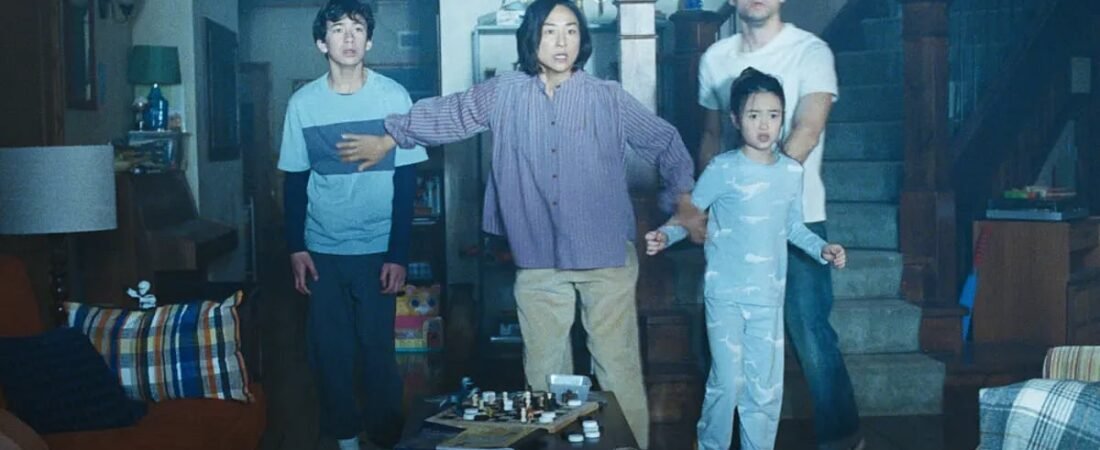
This is a spectacularly unhinged two hours of television-adjacent cinema, assembled as though someone fed a locked-room thriller, a creature feature, a post-apocalyptic survival saga riff into a blender, then left the pandemic-metaphor setting on by accident.
By the end, you will understand roughly what happened.
But why should you, is the question.
So what is this movie actually about?
Seattle couple Ann and Jason, along with their children Ruth and Graham, find themselves sealed inside their own house during a rainstorm. The doors will not open. The water appears to have opinions. The neighborhood, in its entirety, has been placed under lock and key.
Naturally, theories circulate: Government experiment, extraterrestrials, some looming environmental reckoning.
The truth is stranger than all of it. The family is being held by enormous sea creatures, Lovecraftian in silhouette, Kraken-adjacent in temperament, and entirely uninterested in negotiating terms. The film, notably, feels no urgency to explain any of this. Instead, it simply watches the family endure.
Days accumulate into weeks, weeks into months. The children are homeschooled. DVDs become currency. Food dwindles. The house stops being a home and becomes, functionally, a bunker with good bones.
Then the film gets considerably darker.
What, exactly, are the creatures?
This is where the film commits fully to its own eccentricity. The monsters read, initially, as extraterrestrial nightmares. But Ruth develops a competing theory: that they are not aliens at all, but ancient sea legends — Leviathan, Kraken, take your pick, finally made flesh. Her logic is disarmingly simple: most of the ocean remains unmapped, so why not assume something has been down there all along, patiently waiting for the lease to run out?
If these creatures can command the rain, perhaps they haven’t invaded our world.
Perhaps we have simply been squatting in theirs.
It is, genuinely, a compelling premise, one the film regrettably declines to develop with any real rigor. We are asked to accept, largely on faith, that these beings surfaced, flooded a major American city, imprisoned entire households, and began culling humanity because, to put it plainly, the planet apparently reverted to previous ownership. The opening shots of ocean debris gesture toward an environmental allegory, a reclamation narrative for a world humans have visibly trashed. But The Last House isn’t interested in underlining its own thesis. It simply shrugs and lets you assume the sea monsters have their reasons.
An ending that is, somehow, about grace
The creature reciprocates. The waters recede, the family is released, and the monsters withdraw. Seattle, for its part, is essentially gone, the Space Needle marooned in open water, the neighborhood erased, the world the family once knew fully submerged.
They find a dead neighbor’s boat.
I want to be careful here: I am not calling this the most emotionally coherent decision a family has made in a post-apocalyptic film. I am simply noting that, two hours in, the dog remains the most vivid character on screen, a genuinely impressive feat of narrative gravity, considering the competition includes sentient rain.
The family sails off into the flooded horizon. The creatures vanish beneath the surface. There is no grand unveiling, no tidy explanation of what the monsters actually wanted, only a ruined Seattle, a family escaping on a boat named for the dog….(still not mentioning what happened, leaving it to your undersanding) and the distinct sense that somewhere in a writers’ room, someone kept raising their hand to ask, “but what if it were weirder?”
The Last House wants, quite sincerely, to be a creature feature, a survival thriller, an environmental parable, and a family drama simultaneously. Whether it earns all four is a fair question.
What isn’t in question: if you leave this film thinking mostly about Cassidy, you are in excellent company.
Lakshana is an entertainment and lifestyle journalist with over a decade of experience. She covers a wide range of stories—from community and health to mental health and inspiring people features.
A passionate K-pop enthusiast, she also enjoys exploring the cultural impact of music and fandoms through her writing.